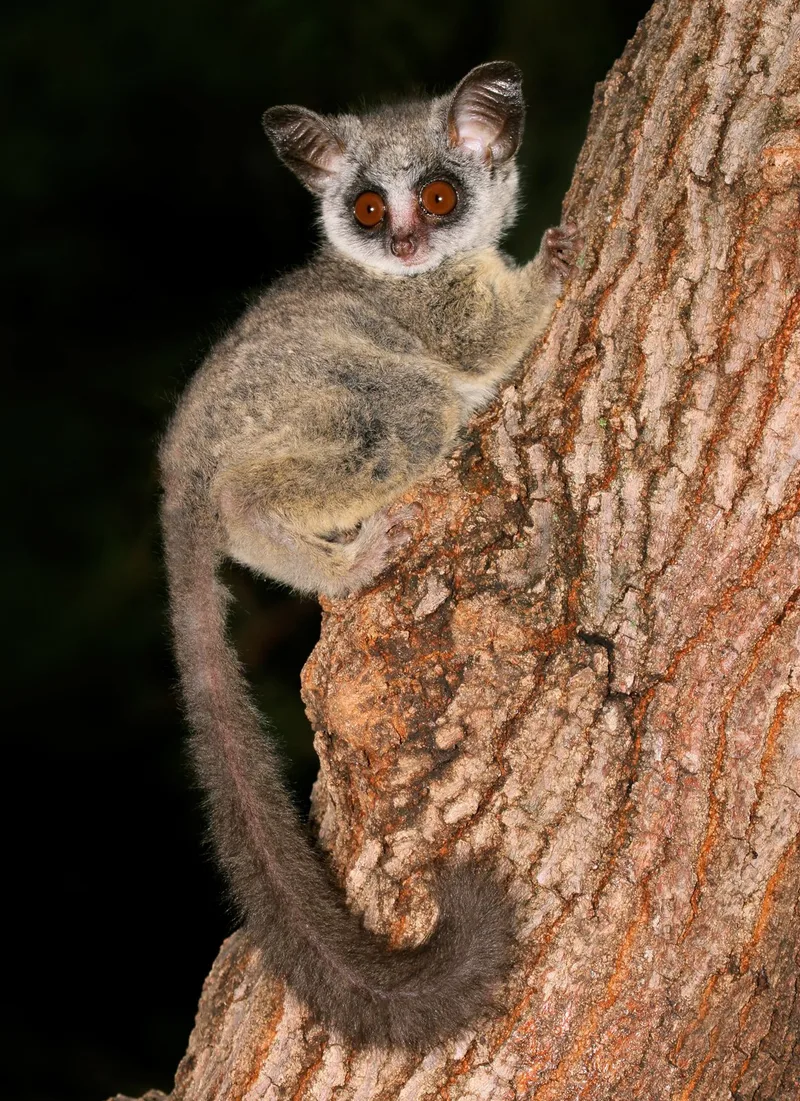
The Lesser Bush Baby — properly Galago moholi, also known as the Southern Lesser Galago — is one of the most unexpected highlights of an evening game drive in the Greater Kruger. The “lesser” is fairly apt: it is a lesser-known mammal of the bush, and for first-time safari travellers it is usually a surprising sighting rather than one they came hoping for. As we move into early winter here at Sausage Tree Safari Camp in Olifants West Nature Reserve, the sparser vegetation makes for easier spotting of these endearing primates, and the first glimpse is almost always the same: two bright orange eyes caught in the tracker’s spotlight, high in a tree.
What a Lesser Bush Baby is
The Lesser Bush Baby belongs to the family Galagidae, a group of small, nocturnal primates found across sub-Saharan Africa. Adults weigh around 150 to 200 grams and measure roughly 15 centimetres head-to-body, with a tail almost as long again. They are part of the “strepsirrhine” branch of the primate tree — the same broad group as lemurs and lorises — which makes them more distantly related to monkeys and apes than the comparable size might suggest.
The name bush baby comes not from their appearance but from the calls of their much larger cousin, the Greater Bush Baby — calls that sound startlingly like a human infant crying. The Lesser is the quieter of the two, but they share the same enormous eyes and the same prodigious nocturnal mobility.
Where they live, and where you’ll see them at Sausage Tree
Lesser Bush Babies range across the savanna, woodland, and riverine forest belts of southern Africa, with confirmed populations across South Africa, Botswana, Zimbabwe, Mozambique, and into Angola. In places where the habitat is right — particularly thickets of Acacia karoo in the South African Lowveld — population densities reach as high as 500 individuals per square kilometre.
In Olifants West Nature Reserve they are present year-round, but most easily seen in the dry winter months when the canopy thins. On a Sausage Tree evening game drive, Themba uses a soft red spotlight to scan the canopy along the riverine sections of our traversing area — that is where most of our sightings happen. The tell-tale is the eyeshine: two intensely bright orange dots, often the only thing visible at first, that resolve into a small primate clinging to a branch if it stays still.
What makes them remarkable
The eyes are the headline. They are large, fixed in their sockets — meaning they cannot swivel — and to compensate the head rotates within an arc of nearly 180 degrees. The ears, similarly large, can move independently of each other. Night vision is excellent, but hearing is the extraordinary sense: slow-motion film has shown a bush baby catching an insect in mid-air during one of its leaps, with its eyes closed (eyes are squeezed shut for protection at the moment of grasp). The catch is made by hearing alone.
The leaps are the other headline. A Lesser Bush Baby can launch itself between branches as far as five metres in a single jump — twenty-five times its own body length. The long tail is essential ballast for the balance work that the leaping demands, and the hind legs carry an outsized proportion of the animal’s muscle mass.
Diet
Diet shifts with the season. In summer, insects and spiders dominate — termites in particular when the alates emerge after rain. In the insect-lean winter months, Lesser Bush Babies turn to the gum that seeps from wounds in Acacia trees, gnawing the wood to encourage gum flow and licking it up over the course of the night. The gum is high in carbohydrate and surprisingly nutritious for an animal that small, and the seasonal switch is one of the reasons populations stay stable through the dry winter.
Family life
Lesser Bush Babies are social: family groups range from two to eight individuals, sharing a tree nest and huddling together to sleep through the day. At night each animal forages alone, often covering as much as two kilometres and visiting up to five hundred trees in a single night.
Grooming is mutual. They use the forward-facing lower canines — a “tooth comb” — and an elongated second digit on the hind foot to work through each other’s fur. There is even a secondary tongue beneath the main tongue, used to clean hair trapped in the tooth comb after a grooming session. It is a level of equipment-specialisation rare in mammals their size.
Territorial marking is done by a dominant male and female who urinate onto their cupped hands and rub it onto their hind feet — leaving a scent trail across the branches they move through. It is unglamorous biology, and it works.
Reproduction
Gestation is approximately 125 days. One or two infants is the usual litter. The young grow quickly and are independent within eight weeks. Young males leave the natal group at the onset of puberty to seek another group — the dispersal mechanism that keeps the local gene pool from inbreeding. Lifespan in the wild can reach ten years.
Predators
The bush is unforgiving for any animal that small. Genets, civets, and owls hunt the same canopy at the same hours, and the long nights of bush-baby foraging are also the long nights of predator hunting. The leaps and the tooth-and-claw equipment are partly defensive — escape rather than confrontation — and the family-group sleeping arrangement provides at least some shared vigilance.
The hand-raised bush babies of Sausage Tree
Occasionally, in houses with thatched roofs in the bush, a mother bush baby will drop one of her newborns and not retrieve it. This becomes an opportunity to hand-raise — Sonja and James have raised several over the years. They are not called babies for nothing: they need feeding every three to four hours around the clock, and the work of raising one is the work of raising any infant.
After about eight weeks, a window is left open at night to encourage them to forage outside, beginning the slow process of reintroduction to the wild. It may take a few months, or up to a few years, but eventually one morning the bush baby simply does not return — having integrated with a local family group, the way it should be. That is the only ending we want for them, and it is the one we have always been able to deliver.
On a Sausage Tree game drive
Lesser Bush Babies are not on the standard “what we hope to see” list that first-time guests bring, but they are almost always among the small handful of unexpected sightings that guests mention afterwards. The best chance is the first hour or two after dark on an evening drive in the dry winter months, in the riverine sections of our traversing area. Tell Themba you would like to spend a few minutes looking for them and the drive can pause for the canopy scan that usually finds at least one pair of bright orange eyes looking back.